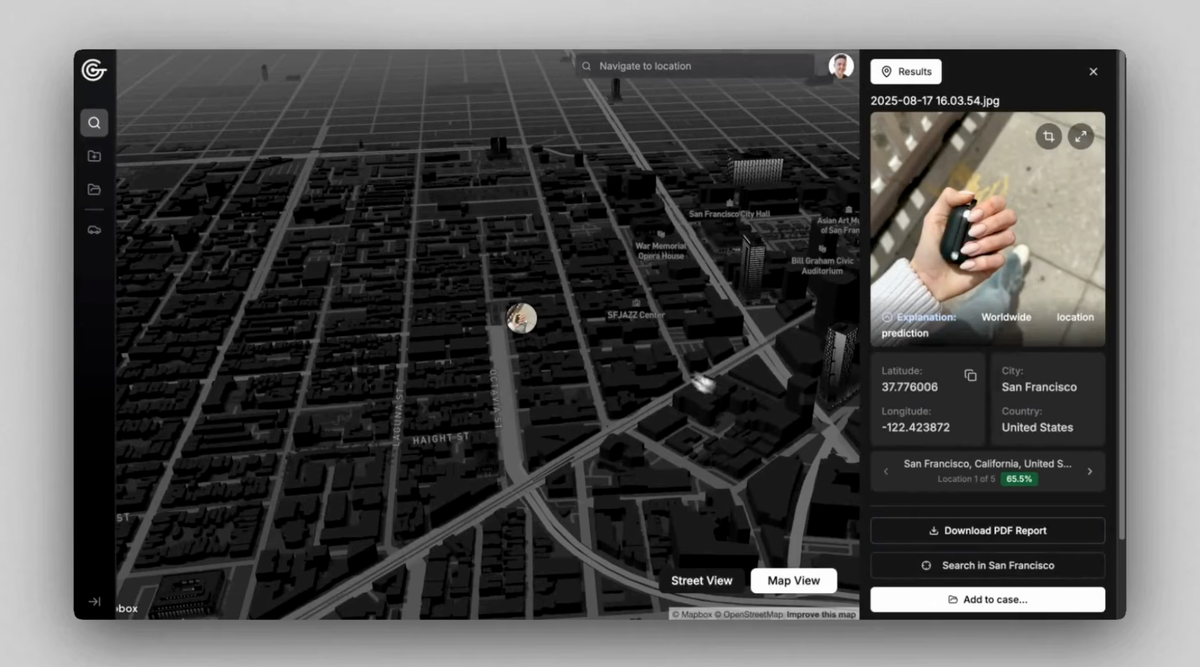
404 Media has obtained a cache of internal police emails showing at least two agencies have bought access to GeoSpy, an AI tool that analyzes architecture, soil, and other features to near instantly geolocate photos.
It’s one of those tasks where it has a bunch of little components, each of which is easy to do (like identifying a store, or mineral formation, or road signs, etc) and so it is a thing that you can design machine learning tools around the individual tasks (‘what is this rock?’) and then instead of needing a highly trained human being to take a few minutes/hours to go through all of the details from memory, you can just push thousands of pictures through an AI system and get ‘good enough’ results.
It seems like there is a company selling such a ‘good enough’ service.
Bingo. You use ML to narrow down results, not to give you answers. I have a friend who uses ML models to analyze radio telescope data, because it’s really good at the mind-numbing work of throwing out noise and junk from broadcast satellites and known radio sources. Then you go through the narrowed stuff to see if anything in that is more interesting.
It’s the question between sifting a million hits or a thousand.
it’s really good at the mind-numbing work of throwing out noise and junk from broadcast satellites and known radio sources.
That’s the key when you’re looking at applications for machine learning. If you can find a task that’s simple but hard to scale because it requires a human expert then it is very likely that a trained neural network can do ‘good enough’ work at 1,000x the speed.
The results won’t be perfect but, then again, they wouldn’t be perfect even if you assigned the project to undergraduates with two decades of training. You still need an expert human supervisor who’s validating the results and tweaking the system.
In these limited cases, machine learning tools are pretty amazing and they give us capabilities that simply were not available to the average person 5 years ago. I’m not on the AI hype train in terms of the current capitalist casino bubble (chatbots and image generators are toys, not an industry), but from an academic point of view these tools are astonishingly powerful in the right context.


It’s one of those tasks where it has a bunch of little components, each of which is easy to do (like identifying a store, or mineral formation, or road signs, etc) and so it is a thing that you can design machine learning tools around the individual tasks (‘what is this rock?’) and then instead of needing a highly trained human being to take a few minutes/hours to go through all of the details from memory, you can just push thousands of pictures through an AI system and get ‘good enough’ results.
It seems like there is a company selling such a ‘good enough’ service.
Bingo. You use ML to narrow down results, not to give you answers. I have a friend who uses ML models to analyze radio telescope data, because it’s really good at the mind-numbing work of throwing out noise and junk from broadcast satellites and known radio sources. Then you go through the narrowed stuff to see if anything in that is more interesting.
It’s the question between sifting a million hits or a thousand.
That’s the key when you’re looking at applications for machine learning. If you can find a task that’s simple but hard to scale because it requires a human expert then it is very likely that a trained neural network can do ‘good enough’ work at 1,000x the speed.
The results won’t be perfect but, then again, they wouldn’t be perfect even if you assigned the project to undergraduates with two decades of training. You still need an expert human supervisor who’s validating the results and tweaking the system.
In these limited cases, machine learning tools are pretty amazing and they give us capabilities that simply were not available to the average person 5 years ago. I’m not on the AI hype train in terms of the current capitalist casino bubble (chatbots and image generators are toys, not an industry), but from an academic point of view these tools are astonishingly powerful in the right context.