

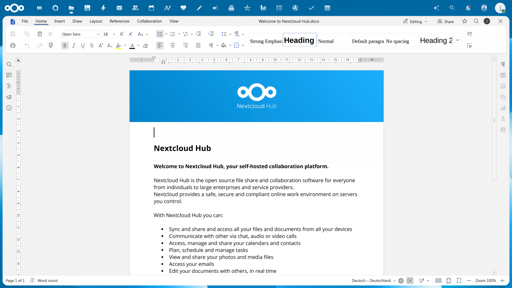
Nextcloud, Ionos and other partners are developing an open-source office suite under the project name „Euro-Office“ as an alternative to the market-dominant Microsoft Office.
The two partners are not starting from scratch, but have forked the components of OnlyOffice available as open-source code and want to build on them. In the summer, the software is then intended to replace the previous office component Collabora in Nextcloud and the Ionos Nextcloud Workspace. A ‘technical preview’ is already available on GitHub.
While this is a good news, I think they should move from github, you know microslop copilot…
I hear this argument a lot but no one ever gives details as to what common features excel has vs say libreoffice. I’m really curious, because i’d like to contribute free time in this direction.
What I always find missing in all these Excel vs. other spreadsheet software debates is the rationale for using a spreadsheet in the first place. I work a lot with large corporations, and it’s often the case that they can’t move away from Excel because, in the past, they relied on it to solve a process in a way that—at least today—could and should be handled better. Perhaps we should question the process more often and the Excel alternatives less.
As a data consultant, I would say those companies already do question the process, and have done for decades.
Yes there are countless situations where a dedicated system or database could and should replace Excel, but there are just as many scenarios where Excel is ideal, and swapping out a spreadsheet for what would be potentially tens of separate applications across the business, or one absurdly expensive behemoth, to perform tasks that could be done rapidly and clearly in Excel is neither practical nor economically viable for most companies. A spreadsheet is perfect for plenty of situations.
My job is literally to help these companies move to appropriate database solutions, often transitioning away from Excel. But there’s no getting around that a spreadsheet solves (often simple) problems that are impractical with other tools. You can move a company to a supplier’s sector-specific solution and solve huge numbers of issues, but unless that solution exactly meets every aspect of the business requirements, there’s always going to be a fallback and it’s often Excel, for better or worse.
My answer isn’t going to be helpful, because I can’t remember specifically what I was doing, but even for a small personal project a year ago, I tried to do something I consider basic, and OnlyOffice (what I was trying out at the time) couldn’t handle it and was ridiculously slow.
Years ago, one of my buddies tried to open a very long spreadsheet and Libreoffice couldn’t do it. I think the maximum row and columns reached parity in version 7. I think one more cosmetic feature that is missing is the easy to access table and chart style templates.
Power Query
I can only assume anyone still asking the question “is Excel really that much better than the alternatives?” lacks exposure to Power Query and its prevalence in business.
Format as table
I’m confused. Excel is a spreadsheet, that’s always in the form of a table.
that downvoter really could have instead done something useful and explain what “format as table” is
A table in Excel will have a name that can be referenced. It will also automatically grow larger when you type in the row under the last row. You can have multiple tables within a sheet. It comes with extensive filters. In LibreCalc you can only set filters but everything else remains static. It’s literally the most used thing in Excel.
You just described the basic functions of a database. People are building a databases in spreadsheets. That’s not a reason to keep using Excel, that’s a reason to have an intervention lol
Edit: this is halfway tongue in cheek. Trying to get office workers to use more and different tools partway through their careers is unfortunately unviable in many industries.