No. It is diagonally opposite. All rear will cause the veichle to fishtail and similar issues with all front braking in case of failure. Thus the parking brake is infact not an emergency brake but a parking brake.
The parking brake is an independent / redundant system. After the hydraulics have fully failed (which, no matter how well designed and built you think the system is, can still happen: https://en.wikipedia.org/wiki/United_Airlines_Flight_232 ), the cable actuated brakes can still serve to get the vehicle stopped more quickly and safely than opening the door and dragging your feet on the ground.
Show me one car that has diagonally opposite hydraulic brakes. I dare you.
They’re all split front/rear because the different axles provide different braking power. Most of the braking happens in the front; rear is primarily for stability. When you press the pedal, in fact, the rear brakes engage slightly before the front in order to add stability while braking.
I’ll look more into it later, learn about its failure modes and whatnot, but off the top of my head, it seems like it would still be a less effective system. I think I would much rather have one axle working. That mitigates the case where the two wheels are on different frictional surfaces, which could leave you with just a single wheel braking.
And still, if the fluid reservoir is a single undivided container, I’m not able to imagine a case where two wheels - horizontal or diagonal - would fail at once.
Examples and Explanation of Diagonally Split Dual Hydraulic Braking Systems
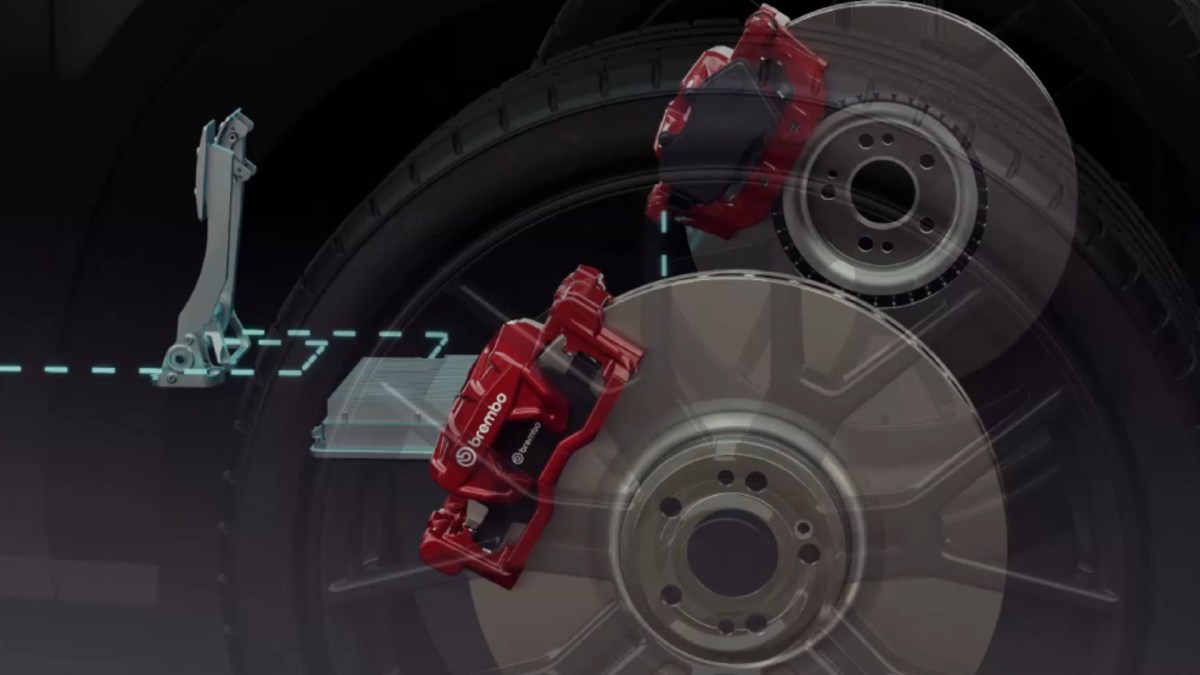
Diagonally arranged (or “diagonal-split”) dual hydraulic braking systems are the standard for most front-wheel-drive (FWD) vehicles. In this setup, one hydraulic circuit controls the front-right and rear-left wheels, while the second circuit handles the front-left and rear-right wheels.
This design is a safety feature: since front brakes provide about 70-80% of a car’s stopping power, a diagonal split ensures that if one circuit fails, you still have one functional front brake and the opposite rear brake to keep the car stable and stopping straight.
Examples of Cars Using Diagonal-Split Systems
Modern FWD Lineups: Most modern FWD cars use this by default. Specific examples include the SEAT Ibiza, Arona, Leon, and Ateca, as well as the majority of Ford’s FWD fleet.
Classic American Cars:
American Motors (AMC): One of the first U.S. adopters, starting in 1967.
General Motors (GM): Widely used in 1980s “X-body” cars like the Chevrolet Citation, Pontiac Phoenix, Oldsmobile Omega, and Buick Skylark, as well as the J-car and A-car platforms.
European Classics:
Saab: Notable in the Saab 96 (specifically the 1971 V4).
Classic Mini: Found on various versions produced between 1976 and 1980.
Other Notable Models:
Toyota Celica: Specifically the 1976 RA23 model.
Audi: Used in several historical models, including the Audi 5000.
In contrast, many Rear-Wheel-Drive (RWD) vehicles use a “front/rear” (black-and-white) split, where one circuit controls the entire front axle and the other controls the rear.


No. It is diagonally opposite. All rear will cause the veichle to fishtail and similar issues with all front braking in case of failure. Thus the parking brake is infact not an emergency brake but a parking brake.
The parking brake is an independent / redundant system. After the hydraulics have fully failed (which, no matter how well designed and built you think the system is, can still happen: https://en.wikipedia.org/wiki/United_Airlines_Flight_232 ), the cable actuated brakes can still serve to get the vehicle stopped more quickly and safely than opening the door and dragging your feet on the ground.
I’ve never seen a braking system that isn’t split between front and rear (except really old cars that aren’t split at all).
You’re probably driving a diagonally split car right now.
Show me one car that has diagonally opposite hydraulic brakes. I dare you.
They’re all split front/rear because the different axles provide different braking power. Most of the braking happens in the front; rear is primarily for stability. When you press the pedal, in fact, the rear brakes engage slightly before the front in order to add stability while braking.
Don’t get sassy with me son, I’ll put you right where you belong.
That’s great but technically: Not a car.
Buuurrrn
Here’s an entire manufacturer: Seat
Interesting, I was unaware of that one.
I’ll look more into it later, learn about its failure modes and whatnot, but off the top of my head, it seems like it would still be a less effective system. I think I would much rather have one axle working. That mitigates the case where the two wheels are on different frictional surfaces, which could leave you with just a single wheel braking.
And still, if the fluid reservoir is a single undivided container, I’m not able to imagine a case where two wheels - horizontal or diagonal - would fail at once.
Examples and Explanation of Diagonally Split Dual Hydraulic Braking Systems
Diagonally arranged (or “diagonal-split”) dual hydraulic braking systems are the standard for most front-wheel-drive (FWD) vehicles. In this setup, one hydraulic circuit controls the front-right and rear-left wheels, while the second circuit handles the front-left and rear-right wheels.
This design is a safety feature: since front brakes provide about 70-80% of a car’s stopping power, a diagonal split ensures that if one circuit fails, you still have one functional front brake and the opposite rear brake to keep the car stable and stopping straight.
Examples of Cars Using Diagonal-Split Systems
In contrast, many Rear-Wheel-Drive (RWD) vehicles use a “front/rear” (black-and-white) split, where one circuit controls the entire front axle and the other controls the rear.
I dArE yOu
LOL. That’s wrong. You are confusing brake bias with brake circuitry.