

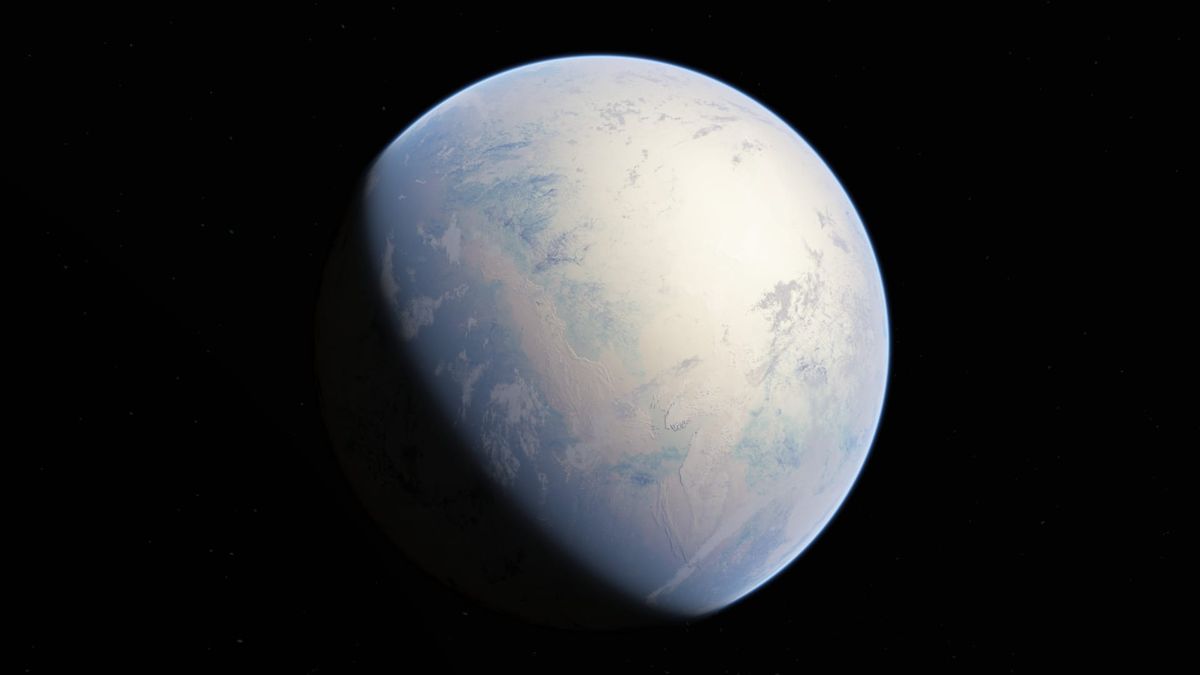
We’re all going to die!
Still a few billion years? We’ll turn it into a junkyard way before then.
Obviously though? Like that’s entropy, it’s fundamentally built in.
I mean when you make it as arbitrary as possible. The universe is terminally unstable and will be completely destroyed. Bit of a nonsensical headline without timelines.
FTA:
The estimated lifespan of the outer solar system has been downgraded from 100 billion years to just a few billion years, according to a study that probed “terminal instability” during the Sun’s death.
FTA:
“Newton’s envisioned instability is real after all,” the team. “He was mistaken only about the perpetrator.”
The news isn’t that the solar system will eventually collapse (the concept of entropy isn’t new) but that the mass loss is not predictable and smooth and the impact of the irregular mass loss fucks with their orbit:
The recently measured white dwarf recoil demands asymmetric mass loss that is most readily attributed to discrete, independently directed ejections that impulsively perturb stellar motion.
People are acting like it’s not a problem, but if we have just one more downgrade of that magnitude, we’ll be in big trouble
is that going to take longer than 30 years?
Nope. One more downgrade like that and the collapse of the solar system will be 88 billion years in the past. It’ll collapse before it even formed, and none of this mess will have happened in the first place. Come to think of it, that doesn’t sound so bad. Since it precedes the big bang, that might help with damage limitation.
Yeah, at that magnitude loss one more and we’d only have tens of millions of years left.
does that mean I can quit my job and go on a hedonistic rampage?
You’re looking at 3 further drops of that magnitude for it to have any meaningful impact on anyone alive today. But if we do have 3 then yes, it’s absolutely time to go apeshit.
I think everyone would be understanding about this today, even.
Bit of a nonsensical headline if you refuse to read the article smh by head
If an article’s title doesn’t make sense until after you read the article, then the title is meant to ensnare rather than inform. Aka click bait.
Finally some good news.
Humans are terminally unstable and will die within an average of 73 years. More at 11.
A few billion years you say? Maybe about 5 Billion?

That episode was wildly optimistic. Earth will be uninhabitable by humans in around 250 million years and the oceans will be boiled away by the sun in 1 billion.
…Unless we destroy it sooner ourselves, of course.
Didn’t they say in the episode that humans had long since left and it was preserved “as it used to be”. I would assume if they had a space station that could survive a supernova they’d have a way to make things fine on the surface.
If we stay around for another million years we may get to the point where we could increase the earth’s orbit, allowing us to stay in the habitable zone for far longer.
Even that isn’t going to necessarily help.
When the sun depletes all of the hydrogen in its core, gravity becomes the dominant force once again and it starts collapsing. Eventually, the temperature and pressure increase from that collapse will ignite helium fusion, but in the time between those two events, the core will have built up some amount of inertia, which means the collapse continues and overshoots the new equilibrium point. This means the temperature and pressure further increase, adding even more helium fusion to counteract it until the pressure generated from that fusion overcomes that inertia.
But this rebound will also be an overshoot, but this time pushing outwards, followed by a reduction in temp/pressure, reducing fusion, then another collapse once gravity overcomes that inertia, and it’ll oscillate like that for some time.
The science isn’t exactly certain about what specifically this will look like but I’d be surprised if it isn’t “strip the atmosphere from the earth, even if it’s already in the new goldilocks zone for once the sun eventually reaches equilibrium” levels of violence, possibly on each outward oscillation after that burst of higher fusion energy.
Oh, there’s also still a huge amount of hydrogen in the outer layers that are collapsing with the core, suddenly being pushed on with the force of helium fusion, that can also ignite hydrogen fusion in the outer layers as it oscillates, adding even more energy, though this could act to dampen the oscillations, but it will still be violent in our direction.
My guess would be best case is humanity is forced to live underground for several million years, if we are able to tune energy gatherers properly to keep producing solar power but not get destroyed by those periodic mini novas.
Also, even if we can manage the heat from the increased radiation, the higher pressure solar winds might overcome our magnetic field during the new equilibrium anyways. There might not be a “goldilocks zone” at all, at least not for our planet, unless maybe we can supercharge our magnetic field, which might be possible since moving to another orbit is already a Type II civilization kind of thing (considering we can’t just move our planet and expect everything to be fine with the rest of them, moving earth outwards will likely require doing something about the gas giants), so the rest of it might be trivial or solvable.
But it’s fun and interesting to think about the details :).
True, if we somehow manage to not kill ourselves off it’s possible we could change it or just leave the planet altogether.
250 million years… you sir are an optimist…
As I said, that’s if we don’t do the job sooner.
Do bring felicitations?
Finally some good news.
Humanity is more terminally unstable, so we win!
Whoever wins, we lose.
Now we compete to rank which humans are most unstable!
I feel like I’m going up the ranks quickly.
This is how you end up with a new Hitler
I think it might already have happened
Not soon enough, unfortunately.
Some 5 year old will hear about this and start panicking.
Insert picture of Big Bird in front of a circle of sitting kids with wide eyes and a speech bubble: “… and after it swallows our entire planet whole, it will destabilize the outer planets, swallowing some of them and hurling others out into inter-stellar space where they will become rogue planets. It doesn’t matter how many vegetables you eat or chores you finish, this eventuality is inevitable, which is today’s word of the day!”
Right along with quicksand and the Bermuda Triangle
So do I hoard toilet paper?
Can’t make more if there aren’t any trees. Better stock up!
anyway we have no clue what will happen when we collide with Andromeda galaxy in a few billions year, Maybe nothing, maybe orbit will be screwed, we don’t know. And the sun will go red dwarf or something anyway in a few billions year. We will all be dead
Can’t be bothered to find a source, but I remember hearing (probably from a Vsauce video or something like that) that it won’t really affect our solar system. Even colliding with another galaxy, the space between stars is so ridiculously fucking huge that the chances of a celestial body getting close enough to pull our planets out of Sol’s orbit is functionally zilch. It’ll still be one hell of a night sky though…
I think either way it’s just speculation how things will be affected. Like space is big but it’s also going to be chaotic af and remember that both galaxies have inner cores containing supermassive black holes and a higher density of stars, as well as both galaxies have satellite galaxies with their own cores that can join in on the chaos. Those black holes have high energy jets that they shoot off perpendicular to their accretion disc, which could get messed with as matter starts coming from all directions instead of generally falling in from the galactic disc.
Currently, the stars in both sets of galaxies have relatively stable stellar orbits and are moving together. The collision will affect those stellar orbits, not just increasing the number of rogue planets flying around out there but also the number of rogue solar systems, including a non-trivial number that will be flung from both galaxies.
No idea what would happen to us if our solar system was one of those. Do we need a galaxy or would it just make the night sky more boring to not be in one?
yup it would be an absolute beauty to see it!
Oh no! A few billion years!
/s
Me too, solar system, me too.